The Pursuit of Happiness: Sermon from Rev. Tom Are, Jr.
Sermon preached July 5, 2026 at Village Church Mission Campus. You may also watch the sermon on YouTube here.
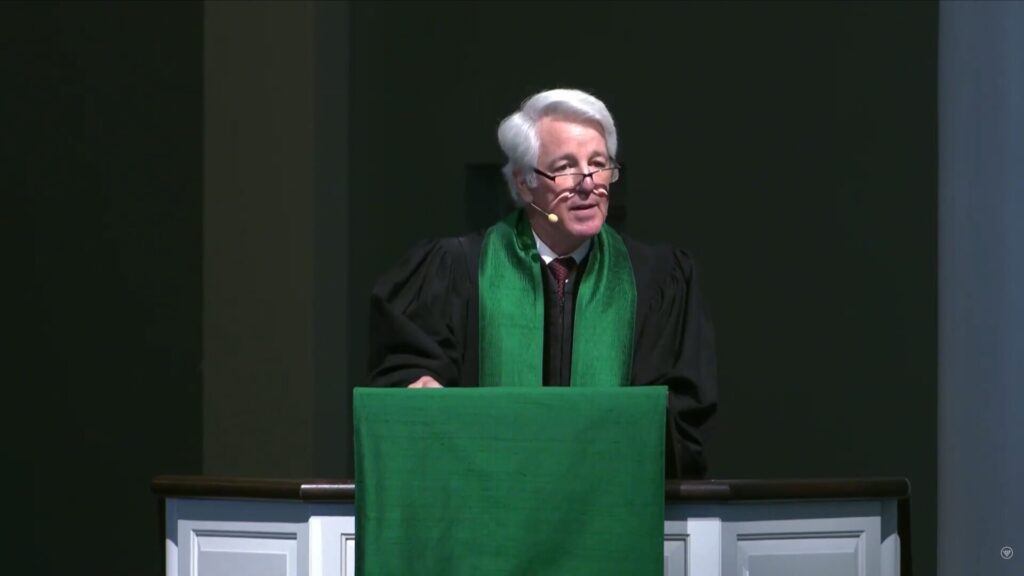
Mark 1:21-28
Tom Are, Jr.
Early in his ministry, Jesus entered a synagogue to teach. In the middle of his teaching, he cast out an unclean spirit (whatever that is). Apparently, the members of the congregation had made their peace with whatever it was that left this person broken. But a consistent trait in Jesus is whenever he encountered human need, he responds with compassion. His choices are consistently shaped by living as a servant for others.[1] The members of the synagogue noticed it, too. They said, “He teaches with authority and not as the scribes.”
The scribes held important positions and they had power. They interpreted the tradition and could enforce their views through judicial proceedings. But, in the eyes of the crowds, with all this power, they evidently lacked authority. Authority and power are similar, but not identical. Power is exercised; authority is demonstrated. Power is coercive; authority is persuasive. Power is feared; authority is respected. Power is the manifestation of strength. Authority results from the demonstration of character. It has a moral quality, a moral authority. Ironically, without authority, power is weakened.
In ninth grade Richard Baker got off the school bus at my stop. He then beat me up, leaving me with a black eye and a bloody nose. He was two years older than I, stood five or six inches taller, and much stronger. For the rest of the school year, I made every effort to avoid him. I feared him, but I never respected him. He had power, but at least in my eyes he lacked authority.
250 years ago, those we refer to as our founders penned their signatures to the Declaration of Independence, giving voice to the self-evident principles of government that would define this new nation. In a paragraph that Jon Meacham deems the most important in the English language, the founders stated that all are created equal, with unalienable rights: life, liberty and the pursuit of happiness.
From my high school days, when I was first introduced to the ideas contained in this celebrated declaration, the most curious of these was the idea that the pursuit of happiness was a self-evident right. I say so because even then it had not been my personal experience. I told my mother that I wanted to attend Stephen Baker’s overnight campout, pitching tents in his back yard. She said, no, I couldn’t go. Fresh from American history class, I informed my mother that the founders insisted that it was my right to pursue my own happiness. I had a right to go.
She reminded me that before Jefferson learned to read, the fifth commandment instructed that you should honor your mother and father…. That your days might be many in the land, implying that if I continued this annoying line of reasoning, my days might not be as many as I hoped. I protested, but lost.
She didn’t point out that my understanding of the pursuit of happiness was flawed, but if she had, she would have been right.
Jeffrey Rosen, law professor at Georgetown and CEO of the National Constitution Center, asserts that the founders drew this phrase from Enlightenment and classical writers of virtue such as John Locke, Plutarch, Cicero and others. These ancient thinkers define “happiness as the pursuit of virtue—as being good, rather than feeling good.”[2] Did you know that?
Historian Helena Rosenblatt says the founders understood that liberty was the “opportunity to become the person that you should be.” She continues, “We think of liberalism as being about individual rights and maximizing our choices. But it was, to them, about making good choices.”[3]
Well, ok, but what does this have to do with governance? Rosen further asserts the Founders were interested in the pursuit of happiness (virtue) not simply as a journey for personal growth, but rather they were convinced that “personal self-government was necessary for political self–government.”[4] For nations to thrive, all citizens, but particularly leaders, must be virtuous or at least pursue the good. A citizen in a democracy, the founders believed, had a responsibility to do the good that is yours to do.
In his early twenties, Benjamin Franklin, inspired by these classical writers, engaged in the quest for moral perfection. Toward that end he created a chart of virtues: temperance, order, frugality, industry—there were twelve in all. The one he put last was chastity, mindful that this one would be challenging for him. He created a spreadsheet with virtues listed on the side of the page and days of the week across the top. At the end of each day, he evaluated himself, making a mark beside the virtues in which he deemed himself deficient. After a few years, a friend encouraged him to add one more virtue from which Franklin would surely benefit: humility.[5]
Franklin admitted that he failed to achieve moral perfection, but the pursuit was, in his judgment, worthy. This is important enough that the Declaration of Independence states the purpose of any government should be to effect the safety and happiness of the citizenry. Good government should give room for citizens to pursue the good. Am I making sense to you?
Of course, even the casual student of history knows that, like Franklin who failed in his quest, America has always fallen short of our self-proclaimed virtues of liberty and justice for all.
Even as Jefferson penned the words that all men were created equal, he excluded America’s people of color. In addition, in spite of Abigail Adams’ plea to “remember the ladies,” women were not seen as equal. Heather Cox Richarson, professor of history at Boston College and voice of conscience in our time, states that in order for the idea of equality to be named, inequality had to be practiced.[6] In other words, when they wrote “all men,” they all understood that they meant “some men.”
This great nation has never achieved the virtues we profess, but we have at least called ourselves to pursue them. Not everyone. There have also been those who insist that America is defined not by the equality the founders proclaimed, but by the inequality the founders practiced. Our history shows that whenever we have sought to broaden the number of those who are included in the equality proclaimed by the Declaration, those steps have been met with a backlash to return to former days of greater inequality.
But I believe when we fail to be good, our response should not be to give up on the ideals but to double down in their pursuit. Like following Jesus, we never achieve the full measure of the Christian life, but following him is our daily calling.
Today, there is a lot of talk about America being great. I think in many ways she is. Her landscapes leave us in awe; her diversity echoes the diversity of Pentecost itself. America has offered the world some of the greatest advances and some of the world’s most inspiring people. But I fear the greatness pursued these days is missing something.
Lincoln, on the blood-soaked fields of Gettysburg, stated the war was in a time of testing to see if any nation devoted to the notion that all people are created equal can long endure.
That question remains. For just such a nation is not a given. A nation devoted to democracy is not a given. A nation devoted to liberty and justice for all is not a given. An America where all are equal under the law—not a given, and it should not be treated casually. Lincoln said that those who survived the war “must be dedicated to the great task before us that government of the people by the people and for the people shall not perish from the earth.”[7]
Every generation must engage in that “great task”, and particularly in our days as we stand in the moment of the 250th anniversary of Independence. We cannot be self-delusional that we will achieve a moral perfection; but we can and we should pursue the good that is possible today. To pursue a nation not simply defined by her power, but by her moral authority, as they said in that ancient synagogue.
But I fear such pursuits are out of step in our nation today. You may see this differently, but let me tell you what I mean. Let me give you just two examples.
Secretary Hegseth, speaking of the war in Iran, said the war would have “no stupid rules of engagement.” Rules of engagement determine when, how, and against whom military power is exercised. Rules of engagement seek to guide the use of force with a moral compass. Do we really find it wiser to announce that we will sever such moral guidelines from our use of power?
In a threat that did so, the President of the United States threatened that we would erase a civilization from the earth. Did you see that? Genocide. Men, women, children, culture, all destroyed.
If I know you and I feel that I do, I cannot image you would celebrate such a demonstration of power severed from moral authority.
President Eisenhower spoke about Viet Nam and said, the “moral position of the United States was to be more guarded than the Tonkin Delta..”[8] Eisenhower was insisting American greatness results from American goodness.
I’ve told you this before… but like everything I told you I am trusting you have forgotten. In 1987 a bicentennial celebration of the drafting of the U.S. Constitution occurred in Philadelphia. Retired Chief Justice Warren Burger presided.
Thurgood Marshall, the old civil rights warrior of Brown v. Topeka, the first African American to be appointed to the highest court, offered a warning about the event. Marshall said, “The celebration invites a complacent belief that the founders already yielded the ‘more perfect Union’ it is said we now enjoy.” Marshall disagreed. He continued, “The Government the Framers devised was defective from the start, requiring several amendments, a civil war, and momentous social transformation” to better realize the promise of a more just society. Credit for the Constitution in its present meaning belonged not to the Framers, Marshall concluded, but “to those who refused to acquiesce in outdated notions of ‘liberty,’ ‘justice,’ and ‘equality’ and who strived to better them.”[9]
Marshall believed in an America defined by the equality voiced by the founders, not the inequality practiced by them. He believed in an America he had yet to see, but had faith was still becoming. He believed America, like happiness itself, is never completely obtained; she is always pursued.
Heather Cox Richardson wrote, “The true history of American Democracy is that it is never finished. It is the story of people who have honored the idea that a nation can be based not in land or religion or race or hierarchies, but rather in the concept of human equality.”
Here Richardson echoes Jefferson, who in a letter written in 1790 wrote, “The ground of liberty is to be gained by inches and we must be content to secure what we can from time to time and eternally press forward for what is yet to get.” I grew up in the Jim Crow South. This church was founded in that same era. As we celebrate 250 years of liberty, echoes of the struggles in those days reverberate around us now. So, it is important to remember, that in those days it was people of virtue, people of character, people of “good will” as Dr. King described them, and people of “good cheer” as Dr. Bob described them, including some of you who were here at the time, who pursued a nation of higher character, of greater authority, and insisted our birth narrative is found not in the inequality the founders practiced but in the equality they proclaimed. Inspired by that generation, we assume the responsibility to do the good that is ours to do that a government of the people, by the people and for the people shall not perish from the earth.
[1] Mark 10:44-45
[2] Jeffery Rosen, The Pursuit of Happiness: How Classical Writers on Virtue Inspired the Lives of the Founders and Defined America, New York: Simon and Schuster, 2024, p. 6
[3] The Ezra Klein Show podcast with Helena Rosenblatt, May 5, 2026
[4] Rosen, 13
[5] Walter Isaacson, Benjamin Franklin: An American Life (2003), p. 89-92
[6] Heather Cox Richardson, Democracy Awakening (2023), p. 164
[7] “Nov. 19, 1863: Lincoln Rededicates the Union at Gettysburg”, Lend Me Your Ears: Great Speeches in History, ed. William Safire (1997), p. 50
[8] . Stephen Ambrose, Eisenhower, (1990), p. 360
[9] . Graetz and Greenhouse, The Burger Court and the Rise of the Judicial Right (2016), pp. 2-3